
Torah as Currency
Are we losing the cornerstone of Jewish identity?

Fourteen million Jews live in the world today. Most can trace their lineage back six or seven generations to observant great-grandparents. Within living memory, Torah was woven into the fabric of nearly every Jewish home.
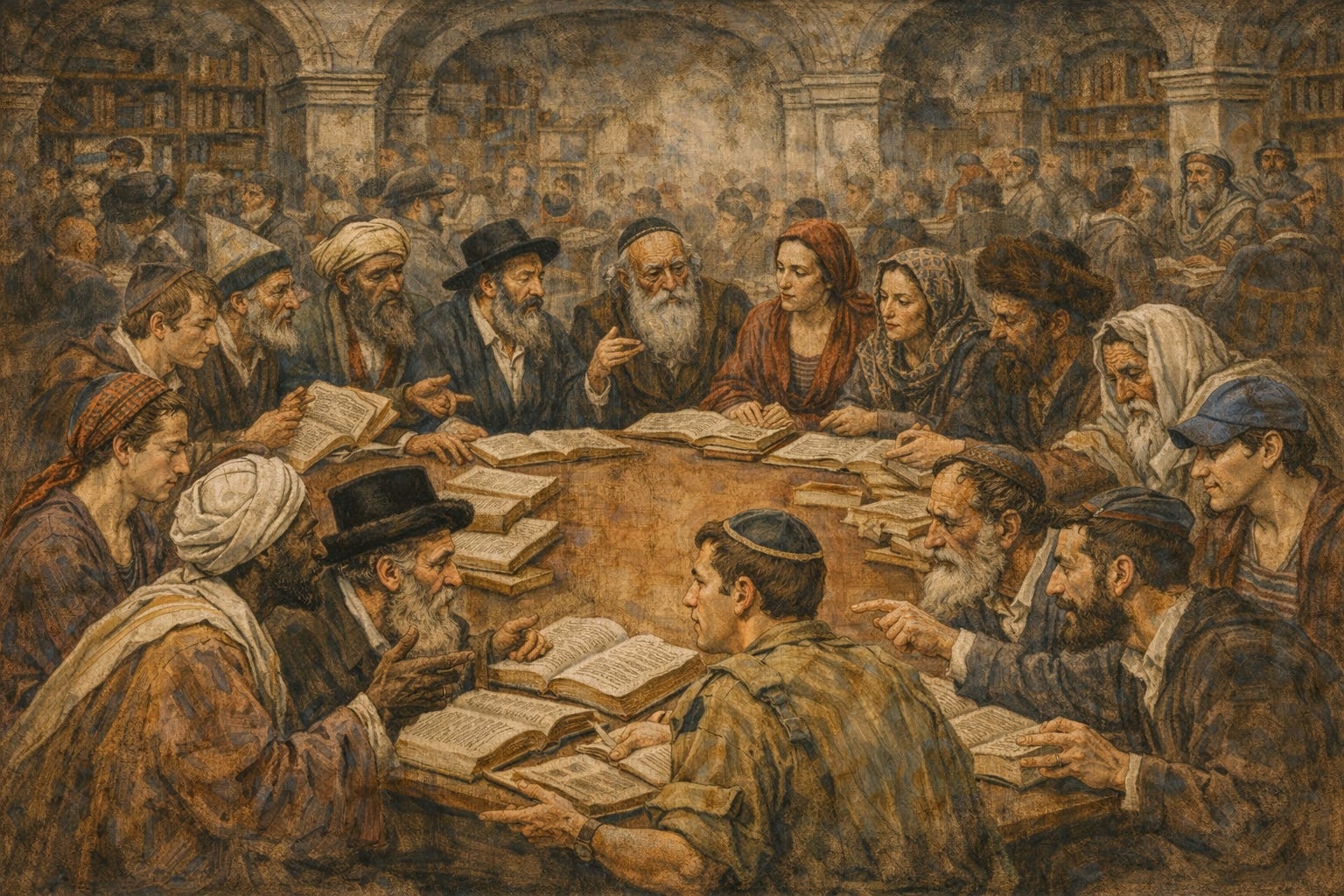
In the span of a century, we have shifted dramatically in practice and affiliation. Yet the vast majority of us descend from people whose lives revolved around Torah. The words of the Torah were recited, studied, argued over, and cherished.
Several years ago, I walked into Sotheby’s in New York to see the Valmadonna Trust collection, the private library of the late Jack Lunzer of London. It was the largest private collection of Hebrew books in the world. I expected to be impressed. I was unprepared for what I encountered.
Room after room, books upon books from floor to ceiling. Incunabula, manuscripts, volumes that had survived expulsions and fires and migrations. The books on the shelves spanned a thousand years. Yet what struck me more than their age or rarity was the way they were arranged.
They were not displayed by author, subject or year. They were arranged by country of origin, alphabetically. Practically every country on earth was represented.
Standing there, I felt the immensity of Jewish history in a way I had never experienced before. There is scarcely a country on earth in which we have not lived, nor a language we have not spoken. There are few cultures in which we have not lived and, in some measure, absorbed. We have changed languages, cuisines, dress, melodies, political systems, and social structures. We have crossed continents and rebuilt ourselves again and again.
There is one thing that throughout it all has never left us: the Torah.
Empires rose and fell around us. Borders shifted. Jewish communities flourished and were destroyed. Through it all, Torah endured as the single constant. If we are here today, it is because that text, its study, and the covenant it embodies, accompanied us through every sojourn.
Torah has essentially been the currency of the Jewish people for three millennia. It has been our shared language across time and geography. It has enabled exchange between Baghdad and Berlin, between Vilna and Fez, between Jerusalem and London. When a Jew opened a Humash or the Talmud, he entered a conversation already in motion for centuries.
Today, most Jews are not observant. A quiet but powerful question for us all is whether Torah still circulates as our currency, or whether it is so only for a small sub-constituency among us while for everyone else it sits on the shelf as a relic.
To claim that it is no longer relevant because we have become enlightened ignores the fact that the foundations of the Jewish mind—from Nobel achievement to elite humour—draw from the words of the Bible and the dialectics of the Talmud. Relegating it to the archives is like throwing away an umbrella during a rainstorm because you aren’t getting wet.
Still, Torah must speak to a world genuinely, robustly, and realistically. It cannot be a conglomerate of parables, spiritual coaching, and abstruse legal discussions. It must be taught and presented as what it was meant to be: a rigorous, ever-expanding wisdom tradition that serves as a framework for reality. The great ones who espoused it treated it as nothing less. We are losing Torah on all fronts.
If we are to strengthen our people, there are three essential points to take seriously.
First: education.
Torah education does not properly begin with ideology. It begins with text. Jewish law obligates parents to teach their children the written Torah, the very verses. The pesukim belong to them. We are custodians entrusted with passing on what is theirs by inheritance.
Several years ago, I gave a tour of Bevis Marks synagogue to a group of secular Israeli schoolteachers. As they sat in the pews, I told them that they were responsible for withholding a treasure from their students. Torah is not the property of the religious. It is the inheritance of every Jew. Place the verses in their mouths and in their memory. Let the words settle deep in the unconscious. Understanding can come later. The first task is transmission of the very text itself.
For centuries, Jewish children were saturated with the words of the Bible. Torah’s words formed the architecture of their inner world. Today, when it is taught at all, we often teach about Torah. We analyse themes and values while neglecting the verses themselves. The text that shaped civilisations and illuminated the moral imagination of the West is ours. Our children deserve direct access to it.
Second: relevance.
Torah and reality must be seen as connected. When tension appears between them, the appropriate response is intellectual labor. We wrestle. We probe. We think more deeply. We refuse to exile Torah from the present. The age-old belief is that the Author of Torah is the Author of the world, and there are no contradictions.
Torah loses its currency when it ceases to genuinely circulate in the real questions of our time. It must address science, politics, psychology, economics, technology, and the great moral questions of the age. That requires teachers who can speak with clarity and courage, who can show how ancient words illuminate contemporary life. Relevance is never dilution. Torah engages the world because it speaks to the world’s deepest structures.
Third: covenant.
The continued existence of the Jewish people defies historical probability. If one traces the arc from Abraham through Sinai, through exile and dispersion, through catastrophe and rebirth, one arrives at a single enduring thread: covenant.
A promise was made. A relationship was forged. Torah is the constitution of that relationship. It defines who we are before God and before history. Every aspect of Jewish life rests within that covenantal frame. Cultural expression, philanthropy, political advocacy, communal institutions—all of these derive their ultimate meaning from the bond between God and the Jewish people.
Torah education anchors the next generation in our national source-text. Relevance ensures that Torah circulates within the present. Covenant reminds us why any of it matters.
We stand in a moment of unprecedented access. Torah is translated, digitised, searchable, and available at the tap of a link. The barriers that once limited study have largely fallen. The responsibility rests squarely on every Jew. If Torah is our currency, we must keep it in motion.
Our ancestors carried it across oceans and deserts. They guarded it in ghettos and marketplaces. They copied it by hand and printed it in exile. The shelves of Jack Lunzer’s library testified to a people who refused to relinquish the source of their identity and bond with the Almighty.
We are the heirs of that devotion and sacrifice. The question before us is whether we will ensure that Torah continues to circulate as the living currency of the Jewish people. Or will we be the ones who leave it behind?
So beautiful.